Wednesday, May 26, 2010

Highlights from a National Correspondent

Just back from a long week in Finland where I was attending the European Museum of the Year Award. This same event started me blogging about a year ago – so it is time for celebrations as an eventful year rolls around, and a thank you to followers of this blog who are so patient with its inconsistencies and randomnic posts.

Cheers! – or, as I learnt from my Estonian colleagues: terviseks, which stands for health and sex!

The event is a highlight of my professional year – and it was absolutely wonderful this year, full of exciting professionals and creative thinkers. Tampere is a small city, called the Manchester of the North for its textile industry. The industrial area founded by the Scotsman James Finlayson bears his name to this day and has been wonderfully readapted as a multifunctional cultural, cinema, restaurant, exhibition quarter. 210,000 people live in Tampere, and there are 100 museums (!!) including the only extant Lenin Museum in the world. As the Mayor of the City mentioned during an opening speech, Finland's rapid progress as a post industrial economy is founded on its profound respect for its industrial heritage, and its ability to transform them into new and inventive public places. The whole experience made for a certain self satisfied, mouth watering museum glut – for which I do not apologise.

I was overjoyed to be offered to become the UK National Correspondent for the European Museum Forum, the organisation that awards the prize annually. I walked into the Sara Hilden Modern Art Gallery in Tampere on Thursday night, a normal person – and came out two hours later honoured by the title. (The photograph above relates to a previous visit to the Gallery).

Talk about the transformative power of museums!

My role will be that of encouraging UK museums to apply for the award and generally make intelligent connections between them and the European museum network. So let’s hear it for diminished isolation of the British museum scene from our European counterparts! Terviseks!

Wednesday, March 24, 2010

Architecture of Science


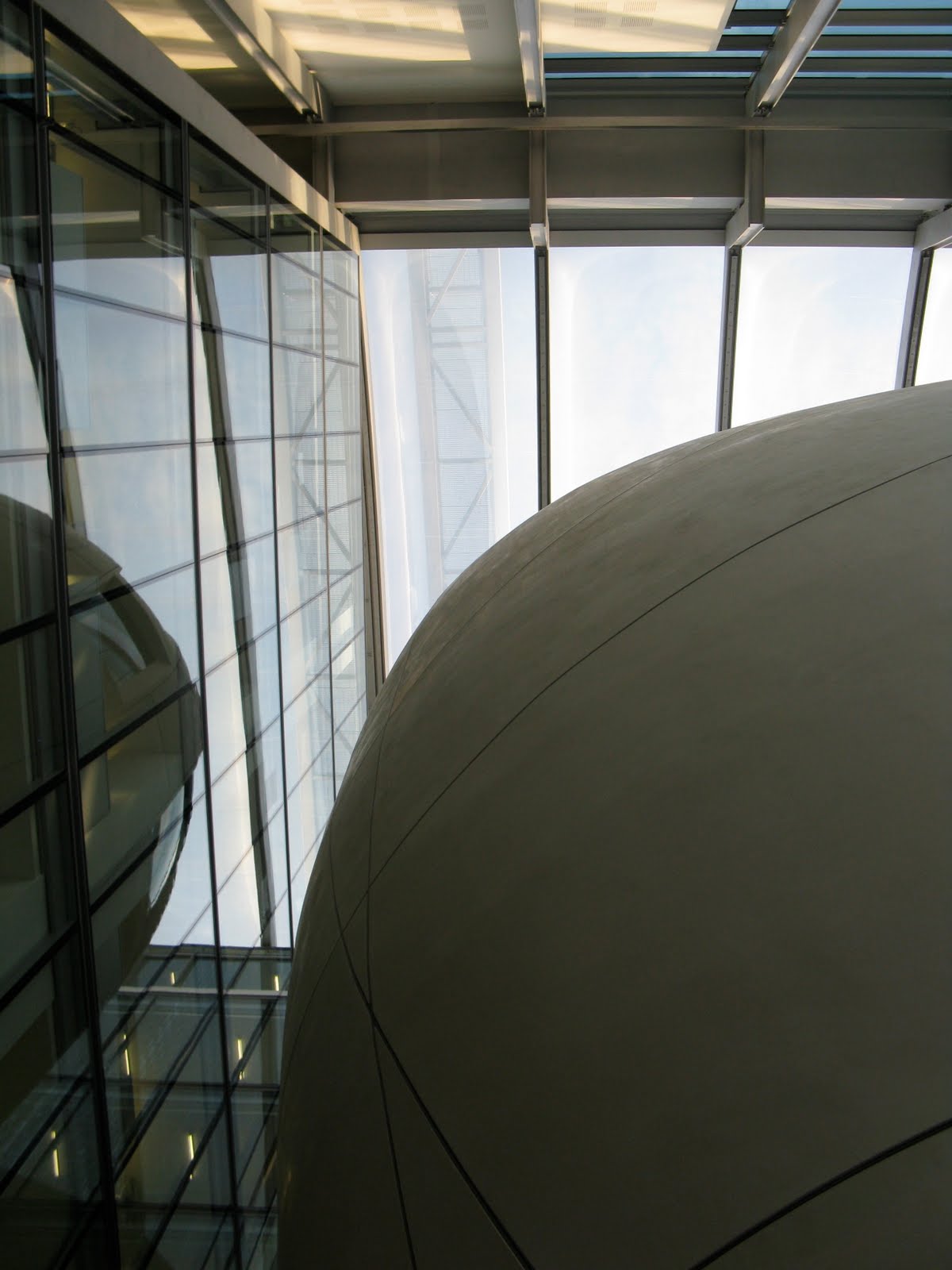
I was invited to the Natural History Museum's showcasing of its new Cocoon structure - an organically shaped, white, seven floor high 'pod' encased by the Darwin Centre, the Museum's new extension to the west of the Cromwell Road entrance. The Darwin Centre is the first new build on the site since 1881 when the Museum moved here - it cost £78 million and took three years to build. It is quite impressive, although not totally original. Designed by C. F. Møller Architects of Denmark, architecturally it echoes other iconic scientific institutions - the dome above the Smithsonian Natural History Museum on the Washington Mall,but more specifically the renowned Butterfly Pavilion contained within:


...as well as a curious experiment at the Centre of the Cell, an interactive science experience for schools, designed by Will Alsop within the Medical Research Building of Queen Mary College in east London:


The pod shape, the organic cocoon, is obviously an inspiration for scientific architecture worldwide. The Cocoon enwraps the huge Spirit collection - so called not because of any ghostly Victorian reminiscence but because the 20 million historic specimens of botany and entomology (plants and insects to you and me) were and are conserved in 'spirit' - jars containing preservation fluids. It must have been the most inflammable piece of real estate in Victorian London!

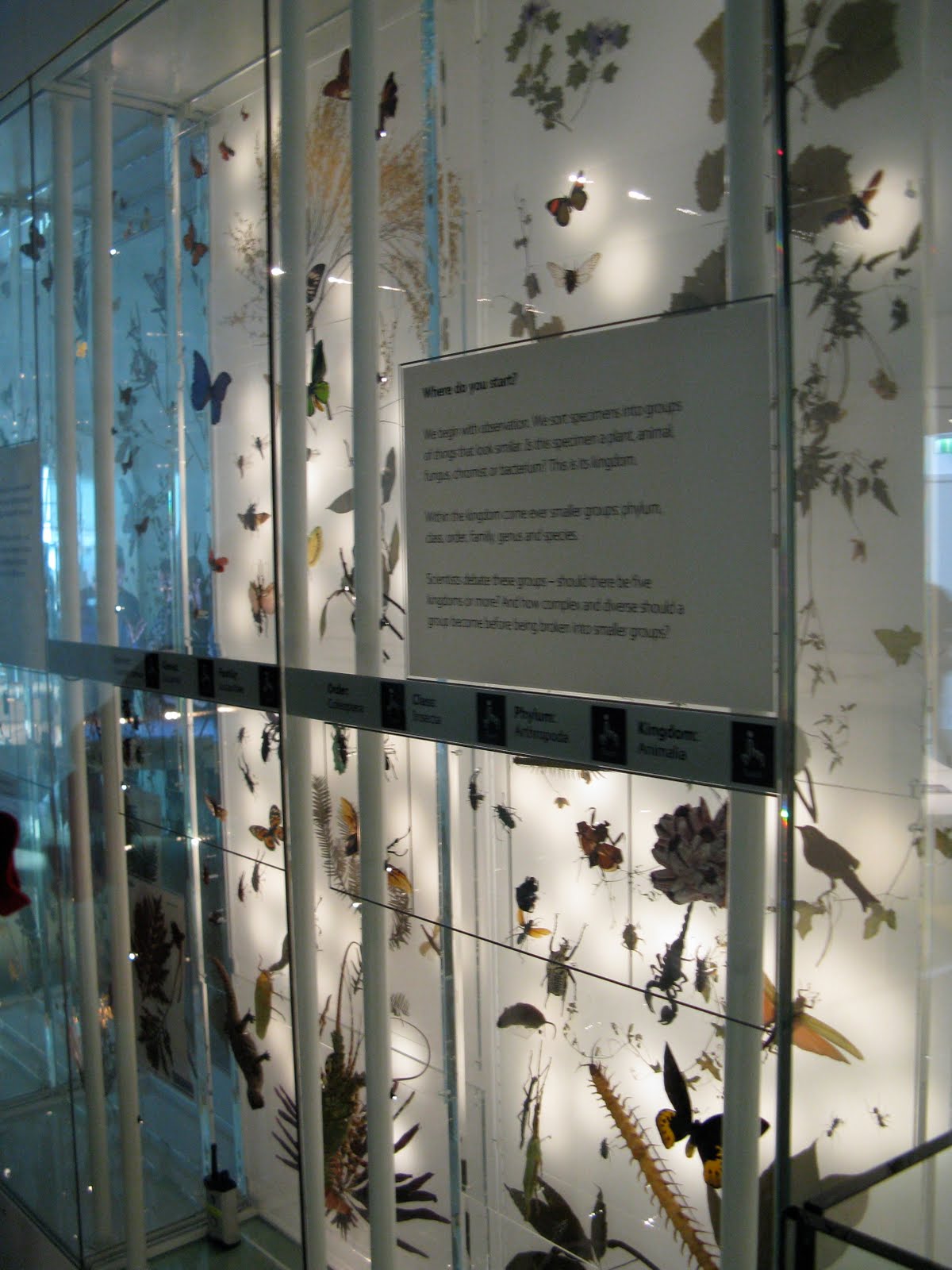
The Cocoon itself resembles nothing as much as a huge dinosaur egg waiting to hatch. What strikes me is how well scientific content is explored within. Circulation through a ramp down 3 floors is punctuated by incredibly beautiful showcases with specimens pinned into the glass panes. The design language seems to preserve the beauty of nature as intact as possible - I seemed to be breathing outdoors, the colours and the freshness of the specimens on show bringing to mind simply the freshness of life and nature outside.

This is quite a feat - to maintain intact the beauty of nature while dissecting it. High tech interactives accompany interpretative insights into the processes of science as a human endeavour - visitors can peek at scientists poring over their research benches and all interpretation - down to the voice in the lift - is delivered by real scientists at the NHM. This is a solid attempt at demistifying science and positioning it in the minds of youngsters and adults alike as human activity. It is refreshing, interpretatively successful and while targetting a younger audience not simplistic or juvenile.


And humour comes in handy, too, in the overarching interpretative approach. The installation I photographed below focuses on a very simple but crucial scientific challenge - that of categorisation. At school we learnt about taxonomy through the study of heavy Latin texts - the Linnean system of Regnum Animale, Vegetabile et Lapideum. From there, the levels were divided into classes, and again into orders genera and species. But the relevance of this was never obvious enough to turn the lesson into something more interesting than a mnemonic exercise. But we categorise and organise every single instant of our lives. By colour, material, shape or sound; by cost, feel, or relevance to the moment... in what we do, or choose to wear; in whom we do what with, in where we go and why. Clusters of complex reasoning, instantaneous decisions made and then reviewed continuously. This process is captured in the miscellaneous selection of unrelated objects displayed in this showcase. By simply surprising our logic capability, it challenges our thinking. Why are these things displayed together? In a sense, it captures the very essence of museological display.


Friday, February 12, 2010

Personnes, Paris


There is something very powerful about walking into huge industrial cathedrals of a bygone era – such as abandoned steelworks, or the vast voids of Battersea Power Station on London’s Southbank, or Tate Modern’s Turbine Hall. The Grand Palais in Paris, which I visited for the first time the last weekend, is one such space, devoted to contemporary art.

It houses Christian Boltanski’s latest installation for Monumenta 2010 – an annual review of art. Personnes can only be described as a reflection on death. As a visitor, you go through a cursory security check, then walk into a rusting wall of numbered boxes set as a barrier in front of your path – you are obliged to walk around it, under its haunting light bulbs. The bulbs, peculiarly reminiscent of those hanging around the fences of concentration camps, were the first indicators, to me, that I was stepping into an installation about death.

With a post modern sense of shock, I became aware of being – not feeling, but being – incredibly lonely in this too-large-to-be-crowded space. Watching people take pictures of each other in front of the huge mound of worn clothes was eery. On the other hand, I felt a sudden warm and irresistible connection to the little kid who picked up her younger toddler brother and pretended to throw him onto the pile – to his immense delight.

The framed quandrangle spaces are much more individual – fewer people walk there, they walk alone, and they walk in silence, as if among gravestones. Those empty clothes, laid out on their front, all pointing forwards, toward the huge mound, don’t resemble corpses at all – but seem to touch a deep fear inside us, of anonymity, genocide, impersonal death by number.

The huge industrial crane that supposedly picks up the clothes from the mound and drops them haphazardly, indicating the randomness of death, was not working when we visited. But the experience was intense, desolate, and I rather imagined its terrifying robotic movement like the breathing of this installation – more terrible than if it had been working.

We walked out very quietly, moved and troubled.

Sunday, January 3, 2010

Becoming a Possibilian in 2010


The Jill Magid exhibition called Authority to Remove - which finishes today at Tate Modern - is a brilliant reflection on the possible relationships between art and secrets, between artistic freedom and institutional power. Tate describes the exhibition thus:

Authority to Remove marks the final chapter of American artist Jill Magid's long involvement with the Dutch secret service, the AIVD. In 2005, she was commissioned by the AIVD (De Algemene Inlichtingen en Veiligheidsdienst) to create an artwork for their new headquarters. This unlikely-seeming invitation came about as the result of a stipulation under Dutch law that a portion of the budget for the new building be spent on an art commission.


In her notes, the artist recounts the process of becoming art thus:


We want you to think of the book as an object of art. We will redact it and put it inside the vitrine with your notebooks where it will remain, permanently.

You want me to put it under glass
so that it will no longer function
as a book but as a sculpture?

Yes. He blinks his eyes rapidly.
It becomes an object of art.
The Director follows this in a soft,
imploring voice.
Will you consider that, Jill?'
(from the Epilogue p. 187)

By displaying her novel as a sculpture on a plinth,
in compliance with the Dutch secret service's
request, Magid's book is transformed
from a narrative into an art object.
Displayed in this way, it can no longer be read,
its secrets secure. The body of the book ripped
from spine becomes a metaphor for the
artist's experience – she has surrendered her first
novel but how can she surrender her memory?


The exhibition got me thinking about the gaps, the missing bits
in our text of life, the things we don't understand, the photographic
negatives - the black silhouettes of experience, I guess we could say.
Hence the weather vane. (The word hence indicating a very
solipsistic logic...apologies. If we think differently, just enjoy
the weather vanes.)

When I first began to think about stories, and how we encounter narrative within a physical dimension, I was in Milan, and I was working in theatre. Nowadays the narrative I work with is not told or acted, but displayed andobjectified.

So when the story is an artwork that reflects on the missing bits - as in Magid's Becoming Tarden (subtitle The secret itself is much more beautiful than its revelation)... well, it is, like all the great epics, all great theatre, all great television plots, ultimately a reflection on death. The negative of our life is by definition - and since hundreds of years before Christian times - exemplified by the concept of death.

Death has been the most tremendously effective tool for narrative plots and myths across all cultures - and a scientifically proven fact for just as long.

Follow me once again down the path of BT-logic, if you will.

Scientists seem to reflect less on death than storytellers, artists and humanists. (I am sure this is a controversial statement, but I admit to not being enough of a scientist to know for sure - let's say this is my impression). But what scientists do just as well as artists, is reflect on possibilities. And hence my other inspiration for the New Year comes from David Eagleman's book Sum, forty tales from the afterlives,a neuroscientific exploration of 40 scenarios of the afterlife - all imaginative, all provocative, and funny.

I will, for 2010, define myself as a possibilian, following in Mr Eagleman's footsteps and attempting to see the afterlife and death as the other side of the coin of life, a way of enriching every living moment and offering us a lens through which to view our shared condition humaine.

Best wishes for the new decade.

Monday, December 7, 2009

Medieval and Renaissance Galleries, Victoria and Albert Museum


The ten new galleries in the east wing of the V&A – which reopened last week to a tune of 32 well spent millions – are very impressive. I could not make the official opening, but pottered around on Sunday with a friend. Designed by McInnes Usher McKnight Architects, the spaces are extraordinary – especially the bizarre and extremely fun new link areas which have created new surface areas and volumes that can happily accommodate entire frontages of houses. We have, of course, seen this before, as museums worldwide struggle to find space in which to make publicly accessible their hidden collections, and re-invent galleries inside their buildings in which to do this. It requires gutting out and re-imagining outside spaces as inside spaces, and making the new architecture work with what remains of the historic building.

Many similar interventions have been hugely successful -
in primis Foster’s Great Court at the British Museum and I. M. Pei’s Deutsches Historische Museum in Berlin. On a smaller scale, but to refer to a project on which I worked, Terry Farrell Architects opening up of vertical circulation within the buildings of the Royal Institution in central London.

But at the V&A the visibility of these
innards – spaces that are external to the buildings that make up what we know as the V&A, an architectural jigsaw behind the unifying Edwardian façade – is bright, exciting and plain fun. It is as if the architects have imagined spilling objects out into the in-between spaces, playing between negative volumes on display and entrail volumes of the building.


Natural light floods in from above, accenting all those stupendous other sunlit marble halls dotted around the building, and the negative volumes sing out against the new spaces. It feels like walking around the cutout silhouette of the main galleries – exactly like when making Christmas biscuits you are left with the non-shapes, where circle sat next to rectangle – and you are left with whatever that in between end shape is. Walking through and around, you find yourself connected to the other galleries. It is a joyous, exciting and uplifting experience.


Thursday, November 12, 2009

Thinking about what I do

I have been reading a very interesting book called Friends of Interpretable Objects, by Miguel Tamen, Professor of Literary Theory at University of Lisbon.

It is a small book, brimming with Portuguese flair and a taste for aesthetics – hence it felt very warm and inviting and triggered many memories of red-wine-fuelled philosophical conversations while writing my dissertation.

Tamen’s most exciting claim is that:

something becomes interpretable, and describable in an intentional way, only in the context of a specific “society of friends".

I am in the middle of dealing with a Friends group at a museum I am helping redevelop, and thankfully the society of friends he refers to is more a spiritual community, united by language and meaning making, than the technical definition comprising these wonderful – and voluntary – supporters of museums all over the world who have such a huge part to play in the renaissance of our sector.

Reading this book has provoked a shift in my perceptions of what I do. I understand all visitors (and possibly even non visitors) as constituting the society of friends that I work with. As an interpretative planner my job is to reflect on the process of meaning making, on how and around what do museum friends come together? In what way do they share meaning making? In Tamen’s terms: how can I help to “characterise language, interpretation and intention-attributing activities” so that messages and experiences that inhabit our museums are shared?

Of course, my answer cannot find expression in a paragraph on this blog. (Not only do I not own the language, I don't actually have the answer yet!) It emerges every day in working creatively around the challenges of an interpretative project. Every project team reveals different understandings and approaches. Even language itself is a cultural barrier in meaning making, as I discovered – for the upteenth time – recently, in my dealings with the Italian Ministry of Culture. My discovery was one of increased self awareness – little to do with professional capability, and lots to do with the need to re-align myself to a different culture of meaning making.

So my thought for this day: each society of friends impacts most profoundly on the interpretative plan that their museum adopts. But... how can we avoid self referentiality? And how does an interpretative planner deal with that? Suggestions?

Sunday, November 1, 2009

Meeting Michelangelo

My time in Volterra was all too short. But time in Italy is a relative concept, and I found myself slowing down a little. A whole day was taken up by lecturing on to postgraduate students studing Museology in the Scuola Normale di Pisa – a very select institution among Italian universities.

On the way out from the lecture theatre, I caught sight of a poster on a church door (Volterra has thirteen churches inside its city walls) which stated in quaint English:


You are welcome, deer tourist guest. Enjoy nature’s beauty and human achievements, and we pray you return home physically rested and spiritually strengthened.

Signed, the Bishop


Spiritually strengthened but physically exhausted, I stepped inside a small alabaster studio where Pupo mastro alabastriere works. A friend had suggested to me that I go and visit this endearing, ancient Volterrano gentleman who works in a studio the size of a large table. Everything here is covered in fine white dust – so fine, in fact, that you don’t really see it: it just seems that a patina of ‘pale’ covers everything, including Pupo – who is very appropriately wearing beige and grey. The dust is of such fine texture that it just seems to make everything a shade paler, rather like looking at a faded photograph or at a landscape through a misty lens.

Slightly selfconsciously, I started to chat to Pupo, whose strong Tuscan accent with its c aspirate is a joy to my ears – it’s a bit like hearing Dante speaking to you.

Pupo described starting work in the family business at age 7, having decided school was boring. He talked about his mother, whose pale picture hung on the side – a birthday picture, wishing her many happy returns for her 103rd birthday (in 2003 if I remember rightly). He talked about working in Milan producing cast models from which castings would be taken, and about the dying art of alabaster. He talked about the figures he makes – many of animals, horse heads and dogs, of birds and turtles, some on commission.

I asked him about his art – what his favourite part of the process was. He looked at me with a twinkle in his eye and said “this” patting the large-ish boulder in front of him sitting atop a swivelling stand on his hand made work bench. Weighing in at about 70 kilos, the bulky shape looked like nothing much, but he explained that he was carving a family of elephants – the small one leading, the mother behind it and the father, the largest form, taking up the rear. He looked up at me, and said “I see them in there”. And so I remembered Michelangelo’s sonnet


Every block of stone has a statue inside it and it is the task of the sculptor to discover it.


Yes, he agreed, it is about taking away what is extra. And do you know the hardest thing? What I still haven’t learned to do? To stop myself before ruining the piece, to listen to my gut when it tells me it will not get any closer to what I have in my mind’s eye, that I should lay aside my tools, and call it a day.

I asked him whether he thought of himself as an artist or an artisan, and he replied that he is neither. “Io sono alabastriere”. Being an artist of alabaster is like nothing else, he said seriously – and paused, looking at me intently. It is a way of life, a way of thinking, a way of passing the time. It keeps me company, he said, and it’s good fun. With these new tools, I don’t have to make any effort at all – he points to a rudimentary drill head attached to a scalpel.

Momentarily, I was lost for words. Here was a man in his 80s, with basic literacy skills, who had single handedly expressed what I had spent 6 hours trying to get my students to understand. The concept that what we learn in life – and in museums – is far less about knowledge than it is about being human. At the heart of this, is the idea of proclaiming a life worth living that has nothing to do with our capacity for intellectual understanding. I had repeated to my students that GLO (generic learning outcomes) indicators used in British museums place knowledge on a par with skills acquisitions and sociality, that analytical capacity goes hand in hand with emotional sensitivity. And that a visit to a museum – or a day in one’s life – spent nurturing our emotional being is worth the time spent poring over a million books.

Volterra Etruscan heart of Italy


I returned yesterday from Volterra in Tuscany – for Etruscan specialists, this is the stoney medieval town Velathri founded by the Etruscans in the 8th c BC. For others among you (including some of my close friends – you know who you are) the location of Stephanie Meyers’ recent bestselling Twilight series.

The city is a vivacious, beautifully intricate medieval town - although 7 kms of the wall walk was laid out by the Etruscans - perched atop a hill, surrounded by the most beautiful rolling hills as far as the eye can see, right down to the sea. The ancient stone walls (la cinta muraria) that embrace the town – and apparently also define whether you are a posh Volterrano or not, ie whether you live entro le mura o fuori le mura – are a feat of stonemasonry and anti-instrusion planning tactics. (Very aptly they also house an imposing prison which still functions today.) They are also used by local kids to engage in sassaiole - or throwing stones onto your friends below the walls.

During one morning run I found it incredibly difficult to find a way back into the city, once I had passed a gate or arch in the ramparts – the walls and routes relentlessly chucked me outwards. This was frustrating at first, and then it made me smile. Any footsoldier in the service of Florentine powers led by Lorenzo il Magnifico who braved the scramble up the steep hill and the hot oil and the enemy snipers would, had he had the misfortune of breaking through without a map, have probably been churned out as soon as he had broken through. Result!

(Volterra did however eventually succumb to Lorenzo's armies in 1472.)

Wednesday, October 7, 2009

The art of language in Paris


I recently returned from an exploration of Paris. The heavily textual/literary character of the French nation is obvious for all to see. The French are proud of their language heritage and manifestly take pleasure in the French language in all its manifestations - the theatre posters in the metro, people reading, the obsession with Littérature moderne du monde francophone, the immense quantity of independent booksellers. Walking into one to browse one I couldn't help hearing the bookseller talking to a young lady whom I guess had asked him advice on reading matter.

Throughout the exchange, he walked calmly around the shop, woman in tow. A strong bright voice, pausing and pointing at the wares as if they were pictures of old friends. The monologue lasted for my entire stay in the shop - I was in there for about 25 minutes.

It went something like this:

...somebody you might like if you read Pennac, a beautifully written Native American narrative like the big epics of past times this is another French classic, and of course Michel Houellebecq if you like the radical. Let me see... Atiq Rahimi won the Goncourt last year we wait to see what he next produces - that was his first novel in French, the great story of an Afghani woman caring for her wounded husband in a repressive society,and another writer who explores the French language exceptionally well - of course, Yasmina Khadra you may know him - What the Day Owes the Night this powerful love story set in Algeria. Do you know Veronique Ovalde (mumble mumble in response) hers are stories to link things together and inseperable - and what about the bestseller Vincent Delecroix - one of my favourites La Chaussure each chapter focusing on a shoe - set in Gare du Nord...do you know the area? It's about loneliness poignant stories. Eric Reinhardt - great writing his is great writing the Cendrillon (Cinderella) novel a sweeping autobiography of four men - I know, I know. But it is autobiographical, and there are four characters...

No surprises, there, then. If all Parisian bookshops are like this one in Pernety, no wonder Parisians are all littéraire.

Museums Association 2009 conference - What I want you do to first is drink a glass of water


I caught up with a couple of interventions at this year's conference - both chosen because of relevance to the practice of using art interventions in museums - manifestly to "open up" collections, "encourage" visitor participation/exploration and/or radically change curatorial practice.

Two things of note.

Edinburgh's The Collective Gallery in 2007-2008 hosted an evaluative exercise on audience participation in interpretation, using works by Jason Nelson, Artur Zmijewski, and Freee (Dave Beech-Andy Hewitt-Mel Jordan) - picture above (http://freee.org.uk/works/how-to-be-hospitable). The gallery's attempt at harnessing multiple perspectives in the development of meaningful interpretations, while a laudable one, left me wondering whether most models of visitor/user generated meaning making are actually a self reflexive exercise that benefits gallery and museum practitioners in the sense that it involves a vocal, interested audience/curatorial panel, while leaving most visitors indifferent. In a postmodern sense, most of these panel based self-reflexive exercises seem to benefit those who take part in them, rather than the end user.

Does reflecting on the mechanics of meaning-making affect end users? Less than it could.
Is this practice legitimate? Even if you are not an artist?

The other excellent case study came from the session entitled "Artists and Museums: what's the limit?" during which Maria Bradshaw, Director of the Whitworth Art Gallery in Manchester, explored what happens when galleries embrace new steps in interpretative practice by involving artists as curators - in this case, the "grande dame of performance art", Marina Abramovic, during this year's Manchester International Festival. In this clip, Marina Abramovic presents the unnerving and unforgettable (see http://www.guardian.co.uk/culture/video/2009/jul/06/marina-abramovic-manchester-festival-adrian-searle).


The Whitworth was cleared of all its collections; artists took part in intimate audience encounters for the duration of the international festival, each performing for an exhausting 4 hours each day; the public were taken through a drill - a sort of initiation ceremony - and finally explored the building freely, observing artists exploring their responses to the space, the (secreted) collections etc.

The lesson learnt was potentially a very strong one: live hauntings, the "renegade energy" of live art injects (can inject) traditional museum/gallery practice with new life, the collections seeming "new" even to their curators.

So why am I cynical?

There is a sense that this style of interpretative intervention - which takes inspiration from promenade theatre and site specific installation work, which turns visitors into private viewers who partake of a bespoke ritual rather than visit... are not our day to day audiences.

When Ms Bradshaw stated "we took this experience as a statement of what we intend to do all the time" - I sighed. It is precisely the "event" nature of the experience, the out-of-the-ordinary exclusiveness, the tailor-made character of becoming one with the gallery spaces and the artworks... that makes this type of experience intensely attractive and socially successful.

The issue is to find ways of maintaining the secretive nature of interesting interpretation - to encourage meaning making in visitors even when there is no special event. Is the solution actually to "open up" collections and "make them more accessible" - or is it, rather, to keep them secret and explorable? Should we encourage visitors to see more - or should we offer them the opportunity of discovering for themselves?

Is access a free exercise, or an initiation ritual of which we partake not as consumers but as co-celebrants? Has access rendered void an encounter with the unknown?